
In any business or project proposal, the executive summary is your first and sometimes only chance to capture your reader’s attention. It’s not just an introduction — it’s a concise snapshot of your proposal’s purpose, value, and expected outcomes. Busy decision-makers, whether they are investors, potential clients, or senior executives, rarely have time to read the entire proposal right away. Instead, they rely on the executive summary to understand what’s at stake and why they should care.
This guide will help you craft an executive summary that is clear, persuasive, and tailored to your audience. You’ll learn what to include, how to structure your points, and how to convey your proposal’s value in just a few paragraphs. Whether you’re writing a business proposal, a funding request, or a project pitch, this article will equip you to create an executive summary that opens doors and wins approvals.
Table of Contents
What Is an Executive Summary in a Proposal?
An executive summary in a proposal is a brief but impactful overview of your entire document. Think of it as the highlight reel that outlines your project’s goals, proposed solutions, and anticipated benefits. Instead of making your audience sift through pages of details, it delivers the key messages they need up front.
The purpose of an executive summary is to help readers quickly assess whether your proposal aligns with their goals or interests. It’s designed to inform and persuade at the same time—giving decision-makers the confidence that your proposal is worth their time and consideration. A strong executive summary makes your proposal more approachable and actionable, encouraging readers to explore further.
The executive summary is typically written by the person who knows the proposal best—this could be a business owner, project manager, sales executive, or consultant. The writer should understand both the proposal’s details and what matters most to the audience.
While the executive summary appears at the beginning of your proposal, it’s often best to draft it last. That way, you’ll have a complete view of your proposal’s contents and can confidently summarize its most important points. Some writers create a rough draft of the summary first to clarify their thinking, then revise it after the proposal is complete. Either way, the goal is a polished summary that accurately reflects the full proposal.
Key Elements of a Proposal Executive Summary
A well-structured executive summary follows a logical flow that helps readers quickly grasp the purpose and value of your proposal. Below are the essential components to include:
Project or Business Overview
Begin your executive summary with a brief introduction to your company or project. Mention what your organization does, its industry, and its core mission as it relates to the proposal. If it’s a project-specific proposal, describe the background of the initiative and why it’s relevant.
Problem or Opportunity Statement
Next, clearly define the problem you aim to solve or the opportunity you intend to seize. This is your chance to demonstrate that you understand the pain points or goals of the decision-makers reading your proposal. Make this section relatable to their business needs or strategic objectives.
Proposed Solution or Project Plan
This is the heart of your summary. Briefly describe what you propose to do. Outline your solution, methodology, or approach, and highlight what makes it effective. Avoid getting bogged down in technical details—instead, emphasize how your approach addresses the problem or opportunity you’ve identified.
Benefits and Value Proposition
Explain what’s in it for the reader. Will your solution improve efficiency, increase revenue, reduce costs, or solve a critical challenge? Highlight the key outcomes and advantages your proposal offers. This section should clearly articulate why your proposal stands out from others.
Budget or Funding Summary (Optional)
If applicable, briefly mention the financial aspect of your proposal. This could be a high-level cost estimate, requested funding, or projected return on investment. Keep it concise—detailed numbers belong in the full proposal.
Call to Action or Next Steps
Conclude your executive summary by guiding the reader toward action. This might be an invitation to schedule a follow-up meeting, begin the project planning phase, or approve funding. Be clear and confident in outlining the next steps.
By covering these elements, your executive summary will provide a complete snapshot of your proposal’s purpose, plan, and potential value—making it easy for stakeholders to say “yes.”
How to Write an Executive Summary for a Business Proposal (Step-by-Step)
Understand Your Audience
Before you write a single word, take a moment to reflect on who will read your proposal. Are they corporate decision-makers, potential investors, government agencies, or nonprofit stakeholders? Each audience has different interests. Some care about financial returns, others about community impact or operational efficiency. Understanding their priorities helps you frame your proposal in a way that resonates. Speak their language—avoid technical jargon if they’re not subject matter experts. Anticipate their concerns and goals, and address them directly in your summary. Ultimately, your executive summary should make them feel understood and confident in your proposed solution.
Start with a Strong Opening
The opening paragraph of your executive summary is your chance to grab attention. Start by clearly stating what your business or project is proposing and why it matters. Use active, confident language. A compelling opening may reference a market opportunity, an urgent problem, or a bold vision for the future. Avoid vague or generic introductions like “This document contains…” Instead, go straight to the point: “Our proposal outlines a scalable marketing solution that will help XYZ Corp. increase online sales by 30% in six months.” A strong opening invites your readers to continue—and take your proposal seriously.
Summarize the Proposal Highlights
This is the core of your executive summary. Lay out the most critical elements of your proposal in clear, straightforward language. Start with a short explanation of the problem or opportunity your proposal addresses. Then outline your solution or approach, emphasizing its benefits. Mention key details like timelines, deliverables, or methodologies—but only at a high level.
If your proposal includes budget figures or a funding request, briefly summarize those too. Conclude this section with a strong value proposition: explain how your solution delivers measurable results, solves a pressing need, or advances your client’s strategic goals. Focus on outcomes, not just actions.
Keep It Concise, Clear, and Persuasive
The best executive summaries are easy to read and hard to ignore. Use short paragraphs, plain language, and logical flow. Cut filler words and buzzwords that add no value. Write persuasively, but avoid overselling. Instead of making empty promises, provide credible claims backed by data or relevant experience.
Remember, your goal is not to retell the whole proposal but to convince your audience to keep reading or approve the next step. After drafting your summary, review it: Does it answer the reader’s “Why should I care?” If not, refine it until it does.
Example Executive Summaries for Proposals
Example 1: Business Proposal Executive Summary
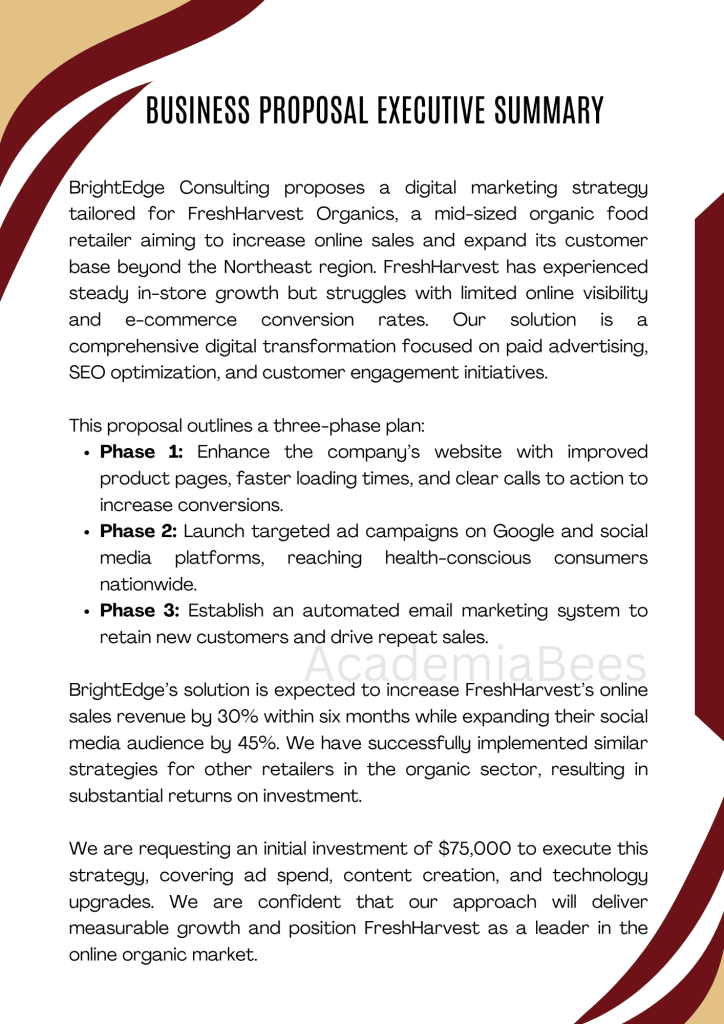
BrightEdge Consulting proposes a digital marketing strategy tailored for FreshHarvest Organics, a mid-sized organic food retailer aiming to increase online sales and expand its customer base beyond the Northeast region. FreshHarvest has experienced steady in-store growth but struggles with limited online visibility and e-commerce conversion rates. Our solution is a comprehensive digital transformation focused on paid advertising, SEO optimization, and customer engagement initiatives.
This proposal outlines a three-phase plan:
- Phase 1: Enhance the company’s website with improved product pages, faster loading times, and clear calls to action to increase conversions.
- Phase 2: Launch targeted ad campaigns on Google and social media platforms, reaching health-conscious consumers nationwide.
- Phase 3: Establish an automated email marketing system to retain new customers and drive repeat sales.
BrightEdge’s solution is expected to increase FreshHarvest’s online sales revenue by 30% within six months while expanding their social media audience by 45%. We have successfully implemented similar strategies for other retailers in the organic sector, resulting in substantial returns on investment.
We are requesting an initial investment of $75,000 to execute this strategy, covering ad spend, content creation, and technology upgrades. We are confident that our approach will deliver measurable growth and position FreshHarvest as a leader in the online organic market.
Example 2: Project Proposal Executive Summary
The City of Westbridge seeks approval for the “Green Streets Initiative,” a community-driven urban revitalization project designed to reduce pollution and improve pedestrian safety in the downtown area. In response to increasing concerns about air quality and traffic-related accidents, this project proposes redesigning three main streets with eco-friendly infrastructure and smart traffic solutions.
The project includes the following key actions:
- Installation of tree-lined sidewalks and bike lanes to encourage walking and cycling.
- Deployment of smart traffic lights to reduce congestion and emissions.
- Implementation of rain gardens to improve stormwater management and beautify public spaces.
Through these measures, we anticipate a 25% decrease in downtown traffic emissions, a 35% increase in pedestrian activity, and improved community well-being. This initiative supports the city’s long-term environmental goals and aligns with federal grant opportunities for sustainable urban development.
The total project cost is estimated at $3.2 million, with $2.5 million requested from the state’s Environmental Innovation Fund and the remainder covered through local funding and public-private partnerships.
The Green Streets Initiative is a collaborative effort involving the City Planning Department, local businesses, and resident committees. Together, we aim to transform Westbridge into a cleaner, safer, and more vibrant urban space. We invite the council’s support to move this impactful project forward.
Common Mistakes to Avoid
Even the strongest proposals can fall flat if the executive summary misses the mark. Here are three common mistakes to avoid:
Being too vague or too detailed:
A vague executive summary leaves your audience confused about what you’re offering. On the other hand, drowning them in too much detail can overwhelm and bore them. Aim for a balanced approach—clear, concise, and informative, giving readers just enough to spark interest.
Focusing too much on your company, not the client:
Your readers care less about your company’s history and more about how your proposal solves their problem. Avoid lengthy company bios or mission statements at the start. Instead, focus on the client’s goals and how your solution creates value for them.
Ignoring the proposal’s objectives:
An executive summary is not just a general description of your business—it’s a pitch for the specific project. Make sure it reflects the proposal’s purpose, scope, and goals. Skipping this leaves readers unclear about what you’re asking them to approve.
By steering clear of these pitfalls, your executive summary will stay focused, relevant, and persuasive.
Frequently Asked Questions
No. An introduction sets the stage for the full proposal. The executive summary is a condensed version of the entire proposal, providing an overview of the problem, solution, and key benefits.
Aim for one to two pages for most business or project proposals. The summary should be long enough to convey the essential details but short enough to be read in a few minutes.
Write it last, after the full proposal is complete. This ensures you fully understand the proposal’s scope, goals, and key points, making your summary accurate and compelling.
Keep technical jargon minimal unless your audience expects it. Focus on the outcomes and benefits rather than the technical process.
Not exactly. While you can reuse some elements, each proposal is unique. Tailor the executive summary to the client’s specific problem and your proposed solution.
Conclusion
Your executive summary is your first—and sometimes only—chance to win over decision-makers. By focusing on your client’s needs and presenting a clear, results-driven solution, you’ll increase the chances of your proposal being read and approved.
Remember, one-size-fits-all summaries rarely succeed. Take the time to customize the executive summary for each proposal, highlighting the most relevant points for that audience. A well-crafted summary shows respect for your reader’s time and attention. Ready to take your proposals to the next level? Explore our other guides on proposal writing, project planning, and persuasive business communication to sharpen your skills and deliver winning proposals every time.

Mohsin Khurshid (MSc IT, MS-CS) is a researcher, academic writer, and technology specialist at AcademiaBees. His expertise includes Computer Science, Information Technology, academic research, programming, databases, software development, and educational technology. Through his articles, he simplifies complex concepts and provides practical, research-based guidance to help students, researchers, and professionals achieve their academic and career goals.